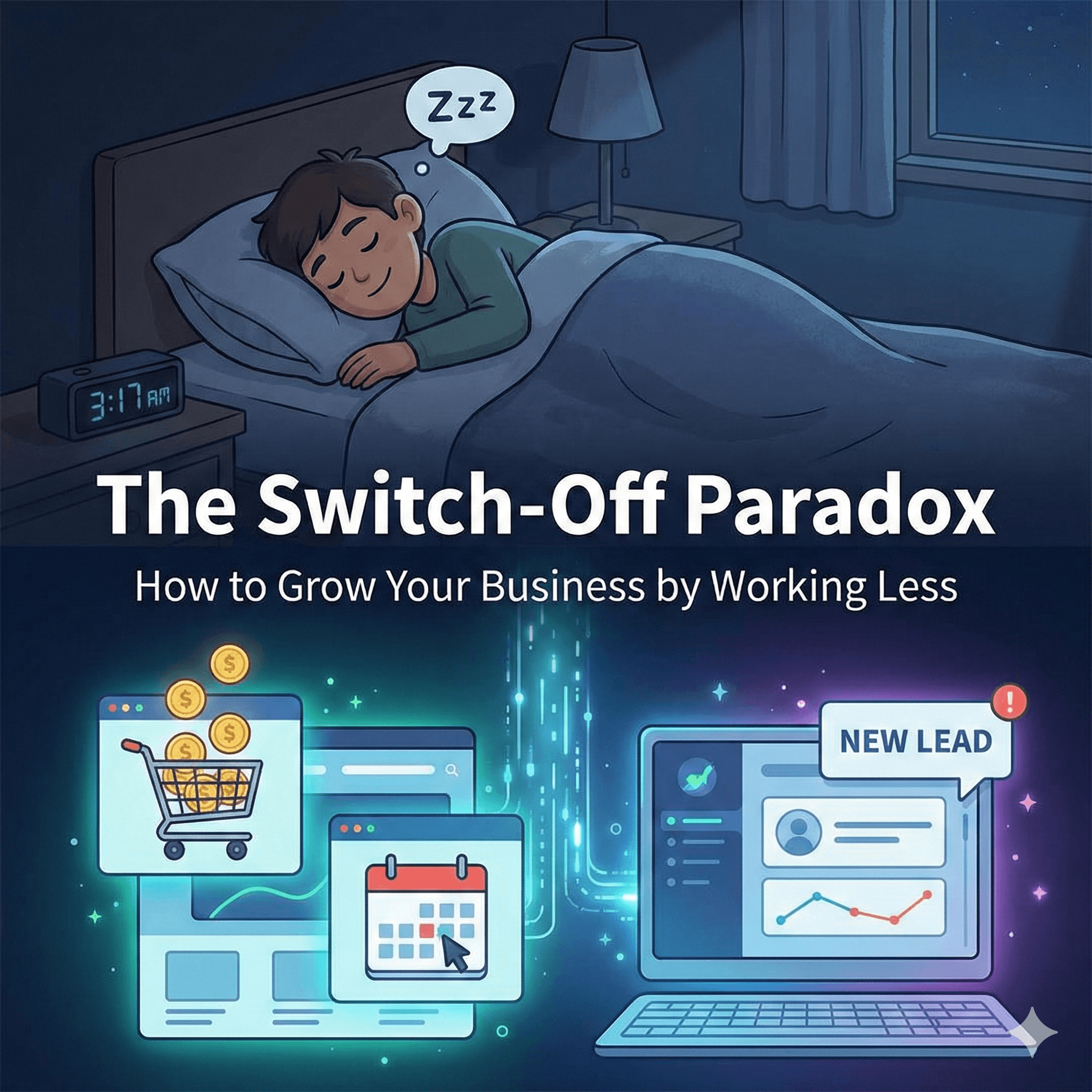
If we could hook every small business owner up to a monitor, we’d likely see a common trend: A low-level hum of anxiety that never quite goes away.
It’s the curse of caring deeply about what you do. When you are the face, the engine, and the safety net of your business, the idea of truly "switching off" feels impossible. Even when you are relaxing with family, or trying to sleep, a part of your brain is still running calculations: Did I reply to that email? Where is the next job coming from? Did I miss a call?
In the old world, if your shop door was locked, you couldn't make money. Your earning potential was tied directly to your physical presence and your awake hours.
Welcome to 2026, where that rule no longer applies.
Today, the most successful small businesses aren't the ones whose owners work 20-hour days. They are the ones who have built systems that allow them to work eight-hour days, while their digital presence works the other sixteen.
Here is why a strategic website is the key to breaking the cycle of constant hustling.
The 3 AM Customer
Your customers don't operate on a 9-to-5 schedule anymore.
People are busy. They are researching plumbers at 10 PM after the kids are asleep. They are looking for a local accountant at 6 AM before their commute. They are browsing for gifts at 3 AM when they can't sleep.
If your business relies on you picking up the phone to capture a lead, you are missing out on dozens of opportunities every single week. You are essentially telling a huge segment of your market: "Sorry, we are closed."
A professional website doesn't need sleep. It doesn't need coffee breaks. It is ready to greet that 3 AM customer with the same enthusiasm and clarity as it does the 10 AM customer.
Moving Beyond "Digital Brochure"
Many small businesses have a website that is essentially a digital business card. It has their phone number, an address, and maybe a paragraph about what they do.
That is a passive tool. It requires the customer to do the heavy lifting (calling or emailing you during business hours).
To truly be able to switch off, your website needs to change from a passive brochure to an active engine.
1. The Automated Salesperson If you sell products, this is obvious: an e-commerce store takes money while you sleep. But service businesses can do this too. A hairdresser can wake up to a fully booked calendar because their site allows 24/7 scheduling. A consultant can wake up to three paid discovery sessions booked into their diary.
2. The Lead Nurturer Someone lands on your site at midnight. They are interested, but not ready to buy. A brochure site lets them leave. An active engine captures them. It offers a valuable piece of content - a guide, a checklist, a discount code -in exchange for an email address. While you are sleeping, your website has just started a relationship with a future customer.
3. The Trust Builder While you are resting, your website is actively proving your worth. Through strategically placed testimonials, case studies, and portfolio images, it is answering the customer's doubts before they even speak to you. By the time you open your inbox in the morning, the lead waiting there is already educated and primed to buy.
Rest as a Strategy
There is a pervasive myth in small business culture that exhaustion is a badge of honour. It isn't. Burnout is a business risk.
You cannot make good strategic decisions, provide excellent service, or lead your team effectively if you are running on fumes.
Investing in a website that works independently of you isn't an indulgence; it's a necessity for sustainable growth. It buys you the peace of mind to actually turn your phone off, knowing that your digital storefront is handling the night shift perfectly.